Penta Power Drill
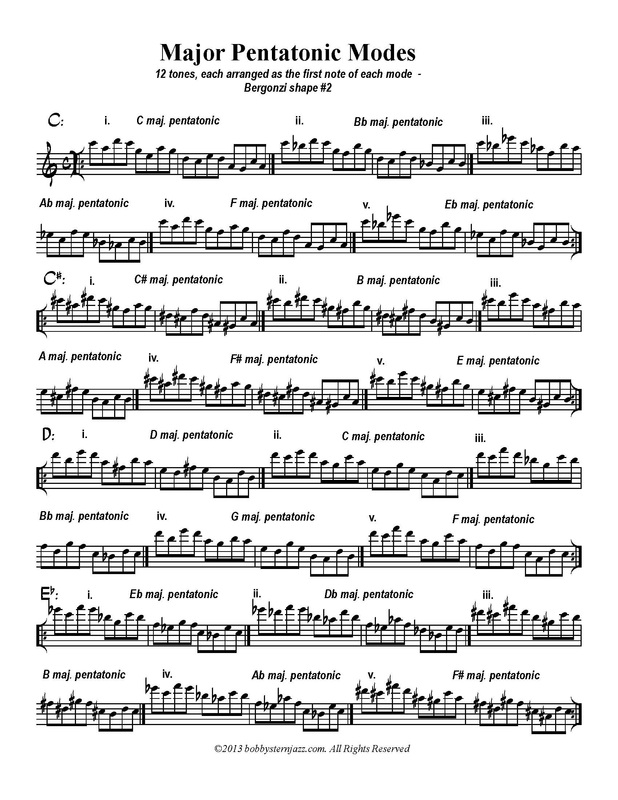
Encouraged by my new friend, New York based tenor saxophone terror Russ Nolan (www.russnolan.com), I'm back again with another helping of 5-mode-oriented Major pentatonic exercises, starting from each of the 12 notes of the chromatic scale and shaped according to formulas nos. 2 & 6 from tenor titan Jerry Bergonzi's popular book, Vol.2 "Pentatonics".
The Major Pentatonic Scale is derived from the Major Scale by omitting the 4th & 7th degrees. As there are 12 Major keys, there are also 12 distinct Major Pentatonics.
We can create 5 distinct modes from any pentatonic scale, one for each note of that scale.
If, however, we choose, to begin each mode on the same note, we then generate five individual pentatonic scales, each from a different key.
The Major Pentatonic Scale is derived from the Major Scale by omitting the 4th & 7th degrees. As there are 12 Major keys, there are also 12 distinct Major Pentatonics.
We can create 5 distinct modes from any pentatonic scale, one for each note of that scale.
If, however, we choose, to begin each mode on the same note, we then generate five individual pentatonic scales, each from a different key.
For example, the note C would be the:
first tone of the "i mode" of C maj. pentatonic (C-D-E-G-A)
first tone of the "ii mode" of Bb maj. pentatonic (C-D-F-G-Bb)
first tone of the "iii mode" of Ab maj. pentatonic (C-Eb-F-Ab-Bb)
first tone of the "iv mode" of F maj. pentatonic (C-D-F-G-A)
first tone of the "v mode" of Eb maj. pentatonic (C-Eb-F-G-Bb)
In other words, there are 5 pentatonic choices for each of the 12 chromatic scale tones, giving us 60 pentatonic modes overall.
Then, factor in the 8 Bergonzi four note intervalic formulas or "shapes", and you've got something to keep you busy for quite some time.
What we're doing here this time is:
first tone of the "i mode" of C maj. pentatonic (C-D-E-G-A)
first tone of the "ii mode" of Bb maj. pentatonic (C-D-F-G-Bb)
first tone of the "iii mode" of Ab maj. pentatonic (C-Eb-F-Ab-Bb)
first tone of the "iv mode" of F maj. pentatonic (C-D-F-G-A)
first tone of the "v mode" of Eb maj. pentatonic (C-Eb-F-G-Bb)
In other words, there are 5 pentatonic choices for each of the 12 chromatic scale tones, giving us 60 pentatonic modes overall.
Then, factor in the 8 Bergonzi four note intervalic formulas or "shapes", and you've got something to keep you busy for quite some time.
What we're doing here this time is:
taking Bergonzi's pentatonic formulas #2, (which is, when applied in this example to the Major Pentatonic scale),
{(C) step down (A) skip step up (D) step down (C) skip step down (A) (pattern repeats)},
and #6,
{(C) step up (D) skip step down (A) step up (C) skip step up (D) (pattern repeats)}, (see graphics below)
{(C) step down (A) skip step up (D) step down (C) skip step down (A) (pattern repeats)},
and #6,
{(C) step up (D) skip step down (A) step up (C) skip step up (D) (pattern repeats)}, (see graphics below)
and applying it to the 12 Major Pentatonic scales; starting each of the 5 pentatonic modes on the same note. It should be understood that a "step" in this case refers to the distance between adjacent notes of the pentatonic, not the diatonic, scale.
Shapes 2 & 6 are linked, in that, as formulas, they are the vertical opposites, or seen as backwards, of each other. As lines, they also move in opposite directions (see graphics).
As with the other posts on note-centric pentatonic modes, this is a great, chops and vocabulary building technical exercise that sounds good and is fun and easy to play at any level.
Previous posts & downloads on the subject: Part 1 & Part 2.
Shapes 2 & 6 are linked, in that, as formulas, they are the vertical opposites, or seen as backwards, of each other. As lines, they also move in opposite directions (see graphics).
As with the other posts on note-centric pentatonic modes, this is a great, chops and vocabulary building technical exercise that sounds good and is fun and easy to play at any level.
Previous posts & downloads on the subject: Part 1 & Part 2.
Download pdf - XPenta Major - Shape #2 Download pdf - XPenta Major - Shape #6
Bass Clef Version Bass Clef Version
Bass Clef Version Bass Clef Version
 | 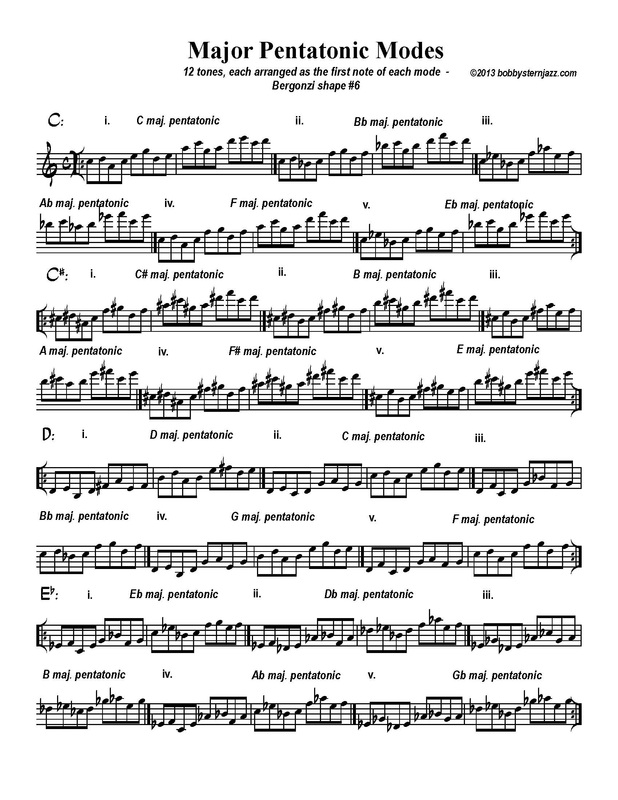 |
Click each image to enlarge
B. Stern
 RSS Feed